Learnings
Self-contained explainer docs on papers in generative 3D graphics — each one a single HTML file, no build step, open directly in a browser.
Docs
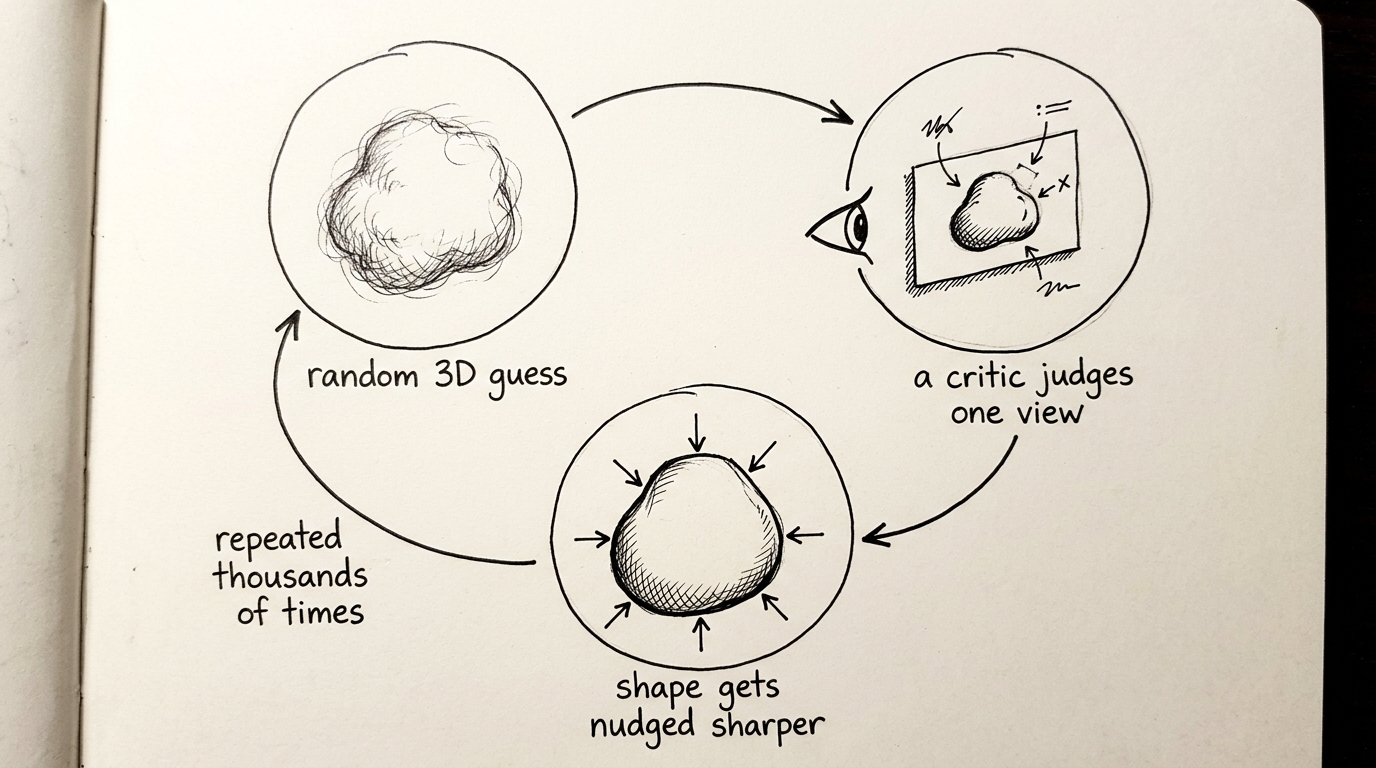
Introduces Score Distillation Sampling (SDS): how a frozen, pretrained 2D image diffusion model can be turned into a differentiable "does this look right" critic for a NeRF's renders, with no 3D training data and no per-shape neural network training — just gradient descent on a NeRF's own parameters, one random camera view at a time. Covers diffusion models, classifier-free guidance, and the SDS gradient derivation from scratch.
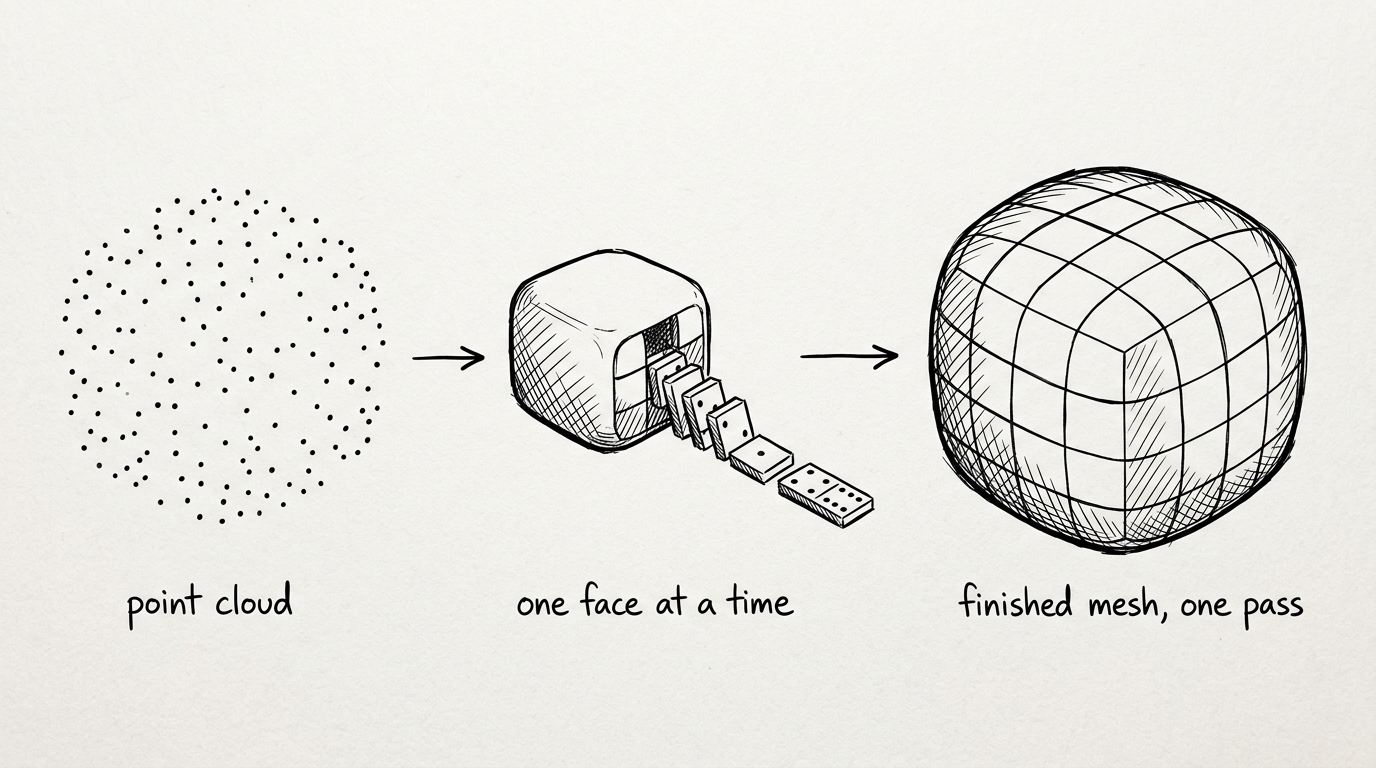
A transformer that turns a point cloud into a clean, quad-dominant, artist-style mesh (≤1600 faces) in a single fast pass — the direct opposite of DreamFusion's per-shape optimization loop. Explains transformers, tokens, embeddings, and autoregressive generation from scratch, plus V2's actual contribution (Adjacent Mesh Tokenization) and why feed-forward 3D generators in general benefit from a higher-quality input shape.
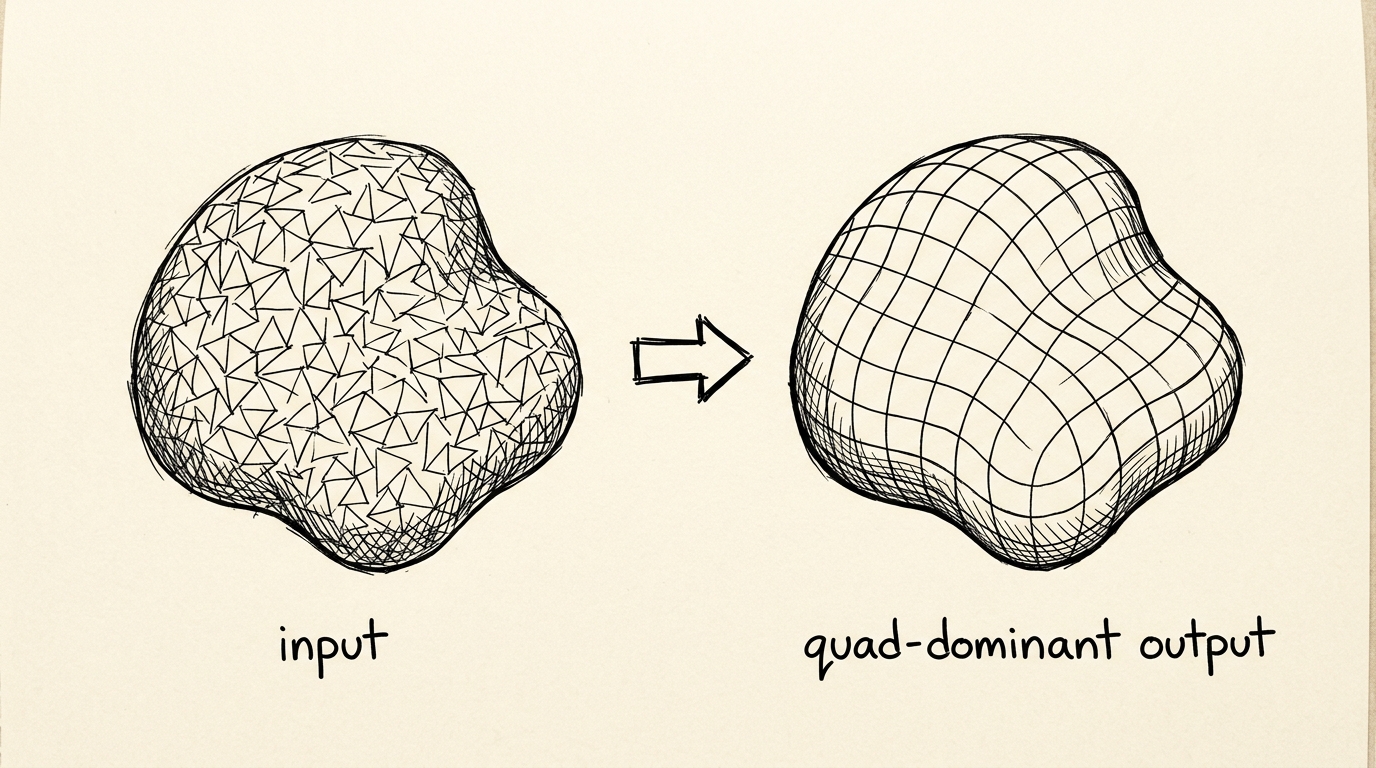
The foundational orientation-field / position-field approach to fast, quad-dominant retopology — works directly on point clouds, no manifold mesh required — using purely local smoothing operators instead of an expensive global solve. Trades global optimality for interactivity; later work exists to recover some of that lost optimality.
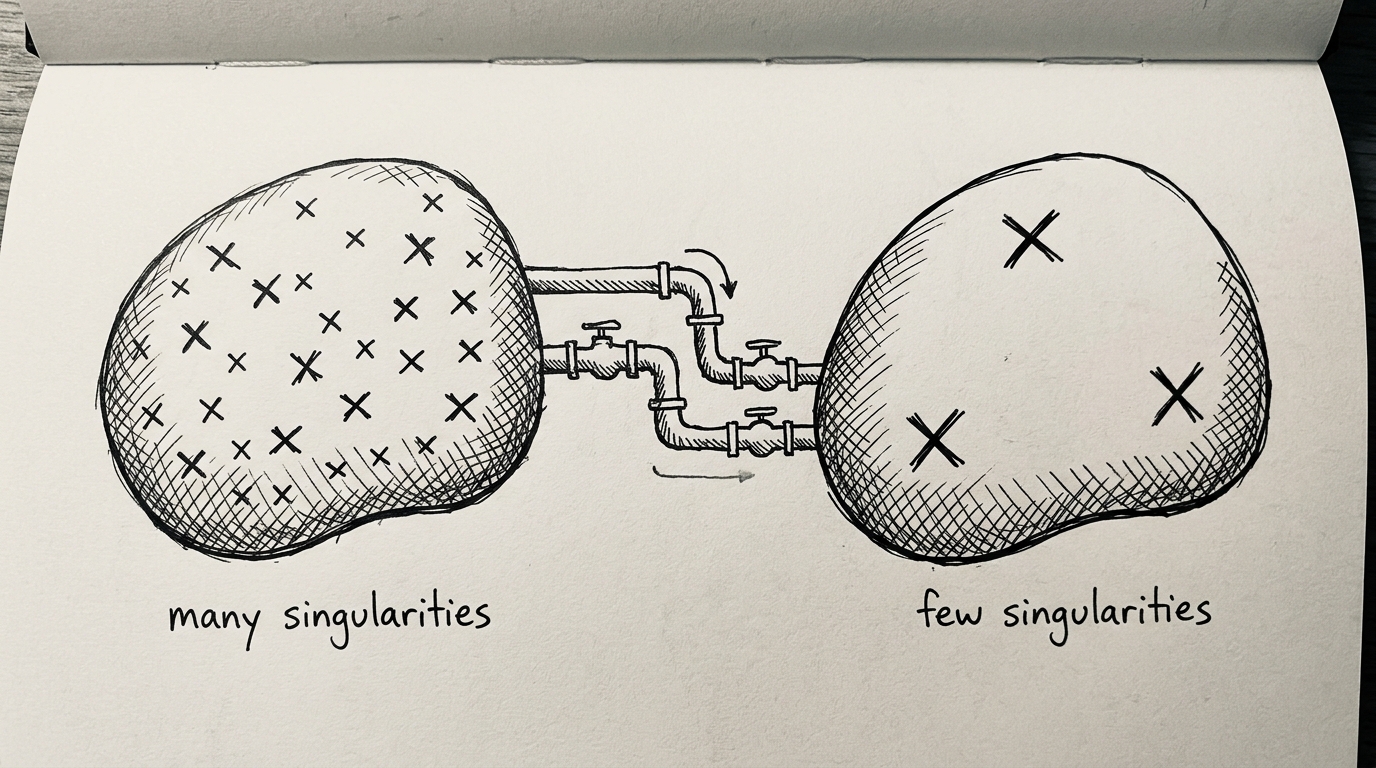
Keeps Instant Meshes' two fields unchanged, but replaces its greedy local singularity cleanup with an exact minimum-cost-flow solve (plus small local SAT problems for face-orientation consistency) — about 4x fewer singularities than Instant Meshes, still under 10 seconds per model. Explains why removing singularities is fundamentally a discrete bookkeeping problem, and how it's made tractable without NP-hard integer programming.
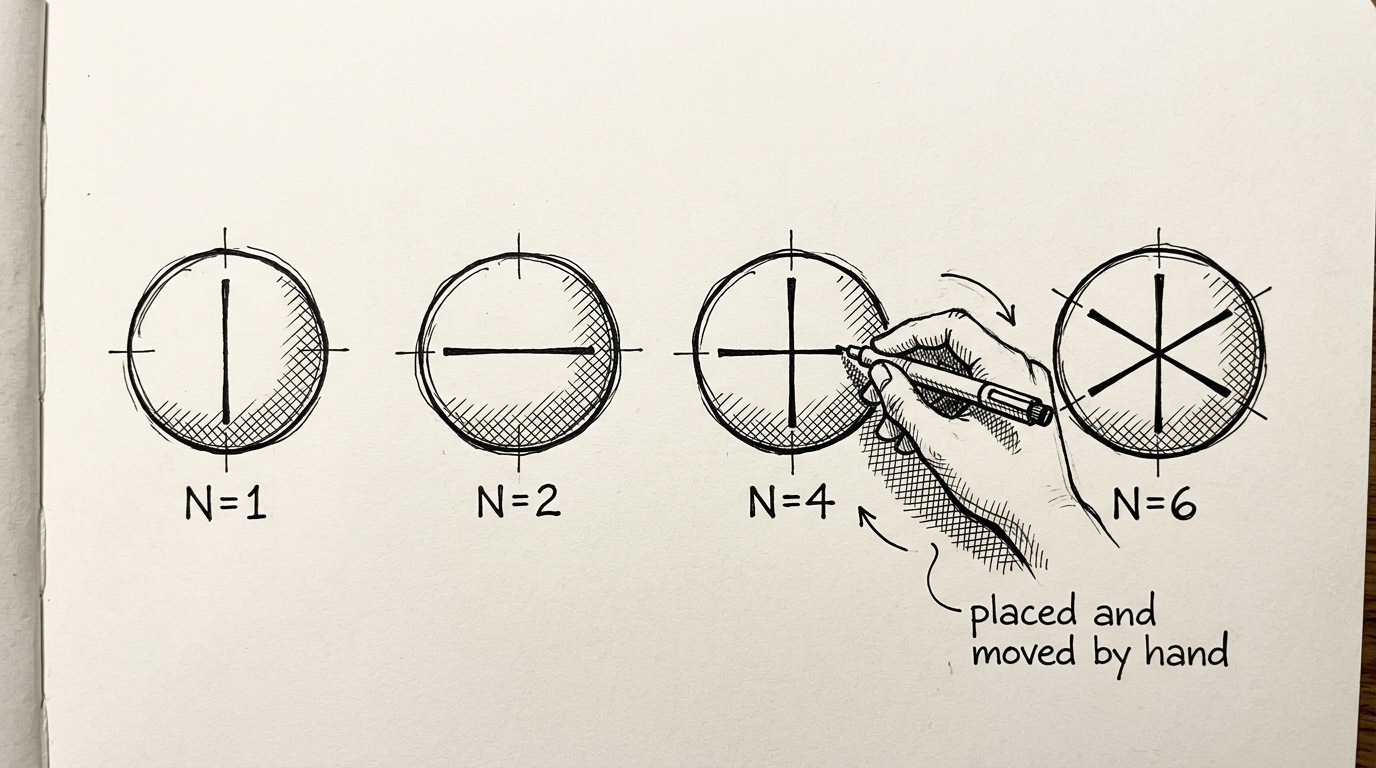
Solves the representation problem that blocks treating N-way symmetric direction fields like ordinary vectors, unlocking interactive, artist-driven placement, cancellation, and movement of field singularities — instead of only being able to smooth a field and accept wherever singularities land.
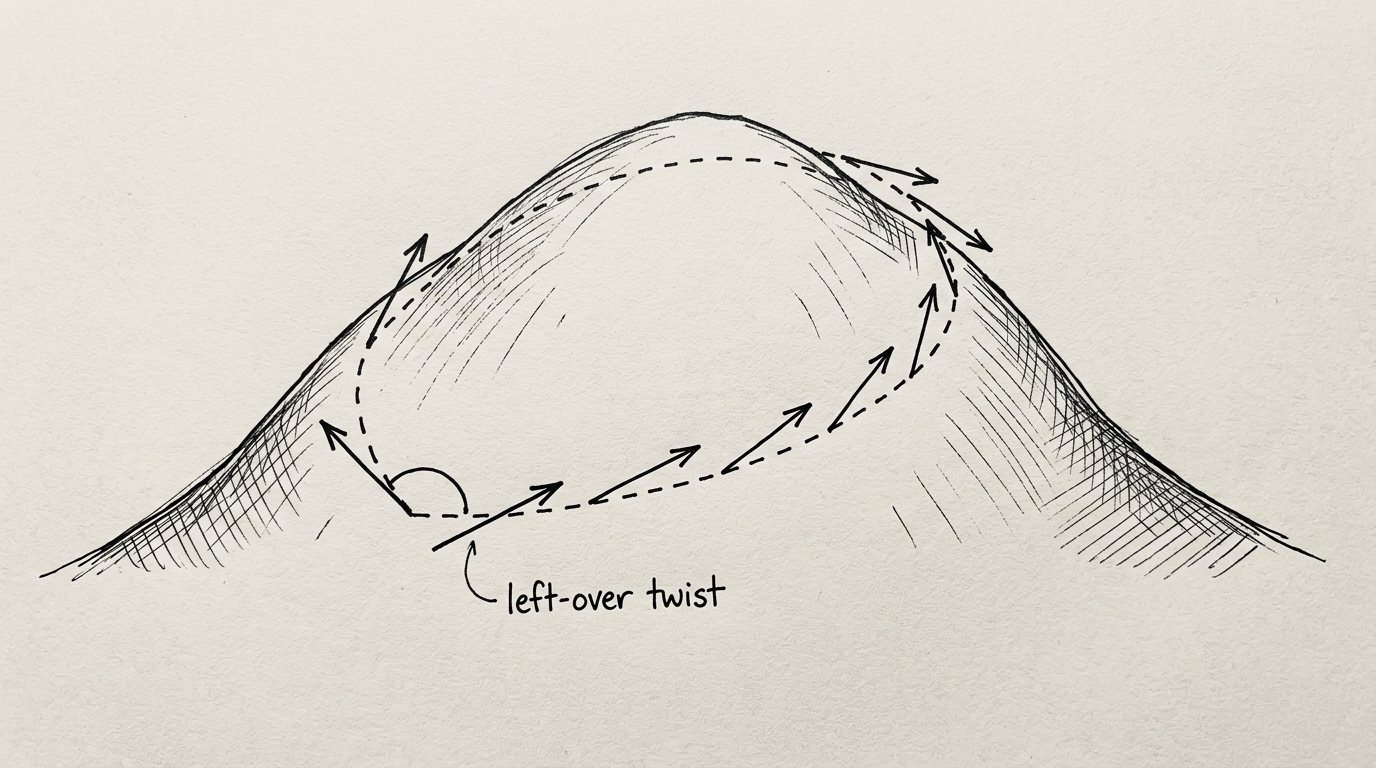
Solves for the connection (per-edge parallel-transport rotation) directly, instead of the vector field itself — one sparse linear system gives the smoothest possible field with singularities at exactly the locations and indices you prescribe, no iteration, no manual sculpting required.
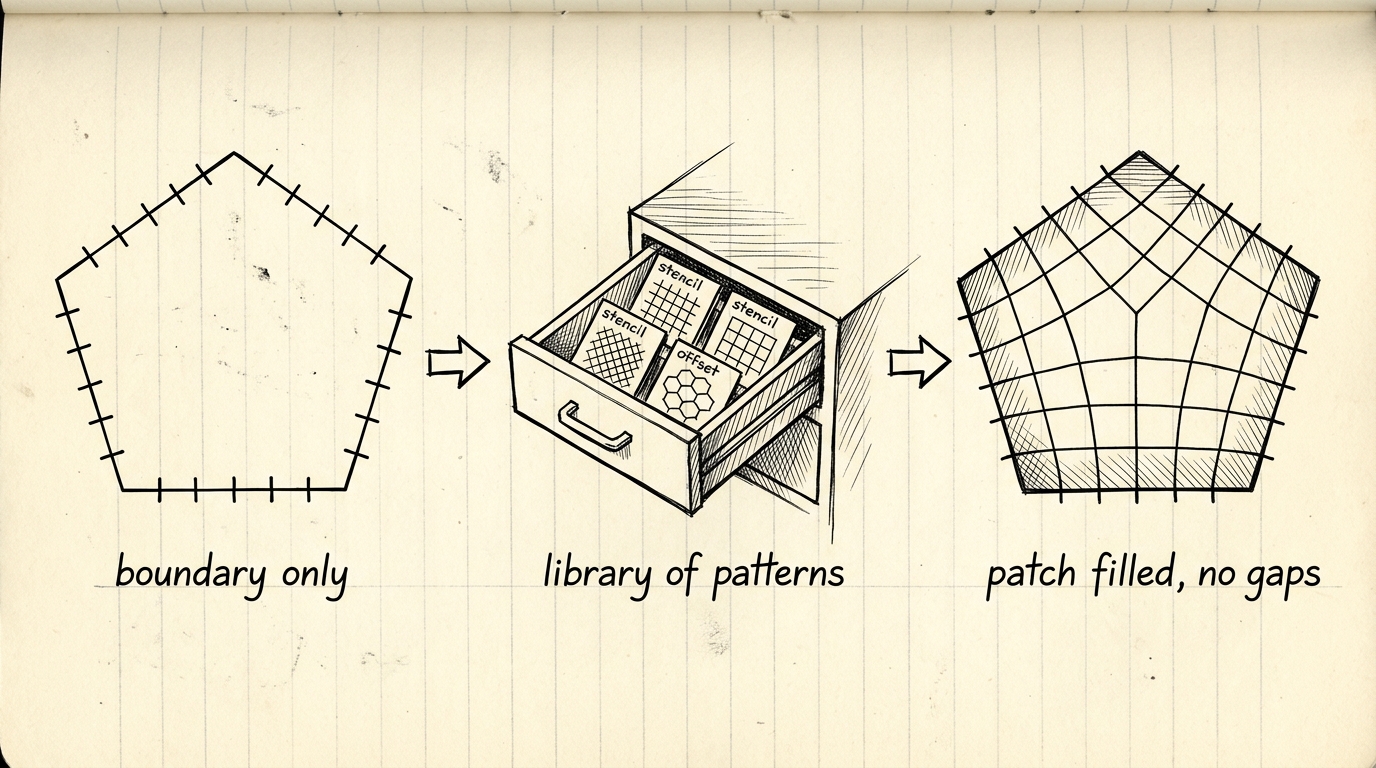
A structurally different alternative to field-based quad remeshing: quadrangulate an isolated disk-shaped patch given only its own boundary edge counts, guaranteed to succeed for any valid input via a small proven-complete library of topological patterns — no manifold assumption about the rest of the model, no global solve at all.
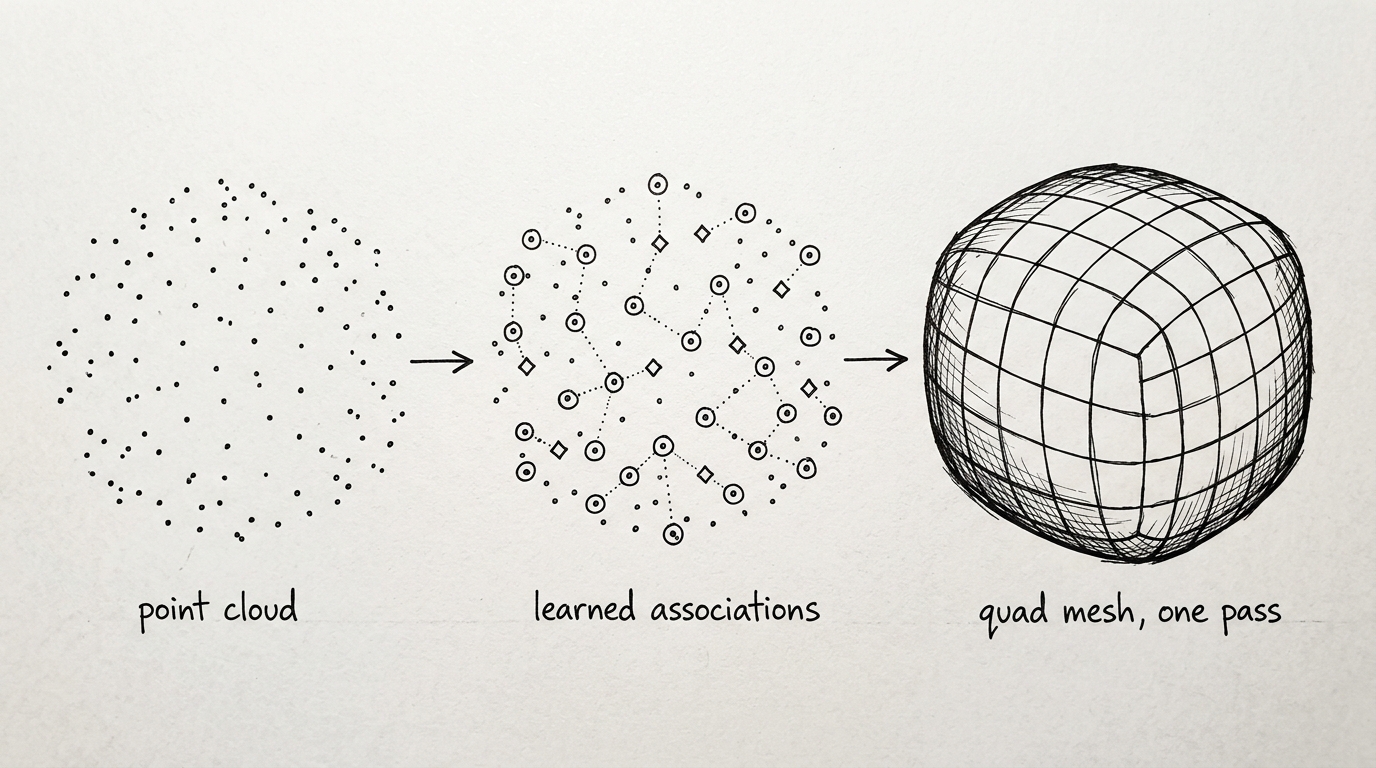
Learns to predict a quad-dominant mesh directly from a point cloud in one feed-forward pass, instead of solving a fresh field/combinatorial problem per shape — the "MeshAnything V2, but native quads" approach. Explains its triplet-margin contrastive mechanism for associating vertices to faces, and argues generating triangles first and converting to quads afterward is fragile when the triangles are machine-generated rather than clean ground truth. No public code/weights yet.